
1xBet NHL Hockey Betting in Canada: Read the Odds, Find the Edge, Stop Leaving Money on the Table
Nobody who has spent real money betting on NHL games needs to be told that hockey is unpredictable. They’ve lived it — a regulation loss on a puck that bounced off a skate blade, a goal that should have been reviewed and wasn’t, a goalie who stopped 43 shots on a Tuesday and looked ordinary three days later. What separates bettors who grind out a profit across a full season from those who break even or worse isn’t access to some secret formula. It’s a sharper understanding of how the odds are built, where they slip, and when to stay out entirely.
This guide focuses on NHL betting through 1xBet for Canadian users in 2026. Not a platform tour. Not a list of bonuses. A working framework for how to think about hockey odds — the parts that most sports betting content glosses over because they require more than a five-minute explanation. (🔥 Join 1XBET now! Click [betx100.com] → Code: betxone → 💰 100% BONUS!)
What the Odds Are Actually Telling You (And What They’re Not)
The biggest conceptual mistake casual hockey bettors make is treating a moneyline as a prediction. A -170 on the Edmonton Oilers is not the sportsbook saying Edmonton has a 70% chance of winning tonight. It’s a price — calibrated to attract enough two-sided action that the book profits regardless of the outcome. Your edge only exists when that price is wrong. Understanding the difference changes how you read every number on the board.

How 1xBet Prices and Moves NHL Lines
1xBet typically opens NHL lines 48 to 72 hours before puck drop. The opening number reflects power ratings, recent form, rest days, and expected goaltender matchups. From that point forward, the line is alive — responding to where money flows, what injury reports surface, and what professional accounts are doing on either side.
A line that barely moves despite obvious public interest on one team is often absorbing sharp action from the opposite side. The public piles on the Leafs, the book holds the Leafs at -175 instead of drifting to -195, because sophisticated money is coming in on the other end and keeping it balanced. That tension isn’t a betting signal by itself, but it tells you the market isn’t aligned with casual sentiment — and that’s worth paying attention to.
Decimal Odds vs. American Odds on 1xBet
1xBet defaults to decimal format for most Canadian users. If you’ve spent years reading American odds, the mental shift takes about a week and then becomes second nature. The table below covers the core conversions:
| Format | Example | What It Means |
|---|---|---|
| American (Favourite) | -170 | Bet $170 to profit $100 |
| American (Underdog) | +145 | Bet $100 to profit $145 |
| Decimal (Favourite) | 1.59 | $1 stake returns $1.59 total |
| Decimal (Underdog) | 2.45 | $1 stake returns $2.45 total |
| Implied Probability | -170 | 62.9% win probability priced in |
One number worth calculating before any bet: the combined implied probability of both sides. Add the implied percentages together and anything above 100% is the book’s margin — the juice. On 1xBet NHL moneylines, that usually runs between 4% and 6.5%. When it’s pushing toward 8% or above, the market is thin and the pricing isn’t working in your favor.
Three NHL Market Types Where the Real Edge Sits
The Puck Line: Why Sharps Love It and Casual Bettors Ignore It
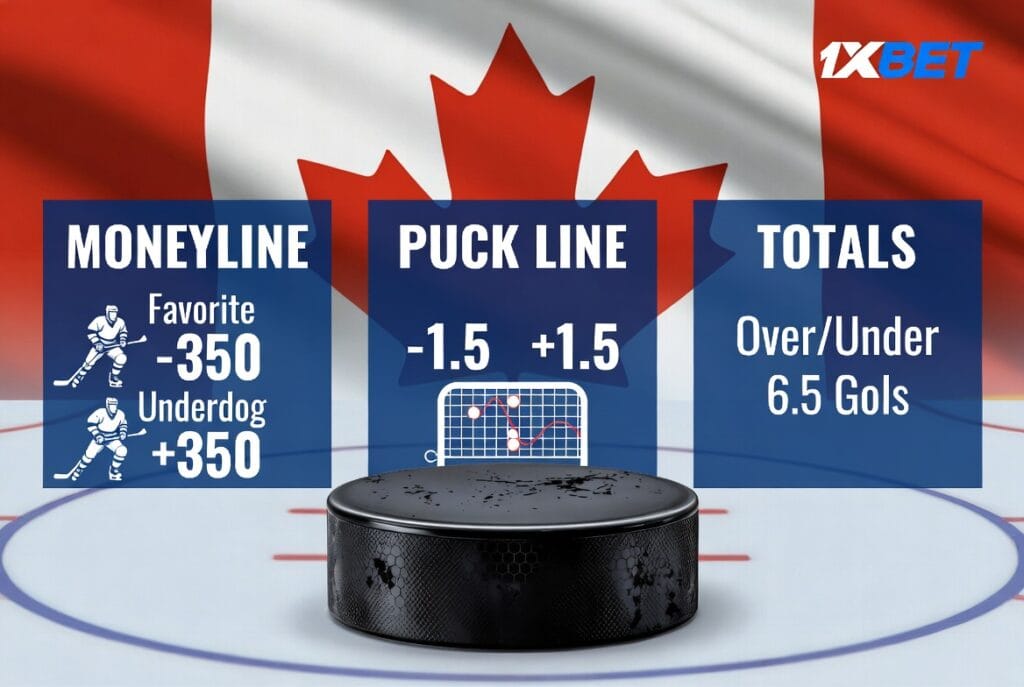
Hockey’s version of a point spread is almost always fixed at -1.5 for the favorite and +1.5 for the underdog. The reason this market is consistently better value than the moneyline comes down to crowd behavior: casual bettors want clean, uncomplicated wins. They take the moneyline because the condition-free outcome feels simpler. That preference concentrates public money on moneylines, which inflates the juice on favorites and leaves puck line pricing comparatively fair.
A team listed at -210 on the moneyline — where you’re risking more than twice your potential profit — might be available at -112 on the -1.5 puck line. You’re accepting the condition that they need to win by two goals, but you’ve slashed the risk-to-reward ratio dramatically. Over a full season of games where one team genuinely outclasses the opponent, the math on the puck line beats the math on the moneyline juice almost every time.
The underdog side is where the pricing anomaly runs deepest. A +170 underdog on the moneyline might be available at -138 on the +1.5 puck line — meaning you’re laying negative money for a team that just needs to stay within one goal or take it to overtime. Historically, that covers a significant portion of games involving genuine underdogs. Negative odds on an underdog condition still represents positive expected value when the underlying probability justifies it.
Period Totals: The Precision Instrument Nobody Talks About
Full-game totals at 5.5 or 6.5 goals are competitive, heavily scrutinized markets. Period totals are a different conversation. The first period specifically — before either team has made meaningful tactical adjustments, before fatigue has touched either goaltender, and before game state has pressured anyone to open up — produces some of the lowest-variance scoring environments in professional hockey.
Teams play controlled, read-and-react hockey in the early stages of a game. They’re measuring the opposition’s systems, avoiding defensive breakdowns, protecting personnel. Books price first-period totals knowing this, but they can’t fully erase the edge because public bettors lean toward overs out of entertainment preference, which means the under gets underweighted in the market pricing almost every night.
On 1xBet, period totals run both pre-game and live, which builds a layered structure. A first-period under priced at -128 before the game might evolve into a live under on remaining period goals within two minutes of a scoreless start — entirely different position, different expected value, based on the same underlying read. These micro-market opportunities are where patience has the highest payout rate.
Live Betting: The Five-Minute Window After Every Momentum Shift

The specific window that experienced NHL live bettors target is the first four to six minutes following a meaningful game-state change — a goal, a power play advantage, a visible coaching mismatch on line changes. The game has shifted. The book’s algorithm is repricing. But it doesn’t reprice everything simultaneously. Some markets adjust instantly; others lag.
The live game moneyline in the middle of the second period is notably slower to reprice following a goal than the period-remaining total. A team that just went up 2-0 at the 8-minute mark of the second sees its remaining period total tighten immediately. The overall game moneyline sometimes takes an additional 90 seconds to fully reflect the new probability. That gap — however narrow — is where live betting converts market inefficiency into profit.
For bettors building structured multi-leg positions or applying chain betting systems to sequential game events, the guide on mastering 1xBet bet types from singles to patents covers how conditional bet structures can be applied to in-play hockey markets in a way that standard single-match tickets simply can’t replicate.
The Canadian Team Factor: How National Loyalty Distorts the Lines
Seven Franchises. One Extremely Biased Betting Public.
Canada’s seven NHL franchises — Edmonton, Winnipeg, Calgary, Vancouver, Ottawa, Montreal, Toronto — share a betting ecosystem that has no real equivalent in American markets. The fan bases are enormous, deeply knowledgeable, and almost entirely unable to separate emotional allegiance from market assessment when money is on the table. The Maple Leafs are the sharpest example of this. Toronto has one of the largest sports betting audiences in the country, and a meaningful portion of that audience bets on the Leafs regardless of odds, matchup, or schedule context.
Books know this and price Leafs games to absorb that volume profitably. A Maple Leafs moneyline on a Wednesday night home game against a weaker opponent might carry an additional 3 to 4 cents of juice compared to what the same matchup would produce in any other market. It doesn’t always make the other side the right bet — sometimes the Leafs genuinely are the play — but it means you should never take a Leafs price at face value without checking whether you’re paying a premium for public sentiment rather than actual probability.
The playoff odds picture as of March 2026 illustrates which Canadian franchises are generating the most distorted pricing:
| Canadian NHL Team | Playoff Status (March 2026) | Betting Market Dynamic |
|---|---|---|
| Edmonton Oilers | Locked in | Heavily backed, prices inflated |
| Montreal Canadiens | Locked in | Strong public support, juice elevated |
| Ottawa Senators | Bubble (thin margin) | Underrated by public, better value |
| Winnipeg Jets | Fading | Late-season deflation still mispriced |
| Toronto Maple Leafs | Underperforming expectations | Emotional premium persists regardless |
| Vancouver Canucks | Injury-dependent | Line volatility creates opportunity |
Back-to-Back Road Games: The Scheduling Variable That Moves Lines Quietly
Cross-country travel in Canada is genuinely brutal in a way the average bettor underappreciates. A Vancouver Canucks team that finishes a game at Rogers Arena at 10 PM Pacific and boards an early flight to Toronto for a 7 PM Eastern start the next day isn’t just tired. Their goaltender’s reaction time is measurably affected. Defensive zone coverage — the detail work that requires full cognitive presence — degrades in the third period at a statistically significant rate.
The NHL has reduced back-to-back scheduling in recent years, which makes the remaining instances more informative, not less. A back-to-back that would’ve been ignored as routine background noise five seasons ago now stands out precisely because it’s unusual. When a line fails to fully account for the second leg of a back-to-back road trip for a Canadian team, that’s mispricing in plain sight.
A Note on Legal Access Across Provinces
Before any wager, Canadian bettors in 2026 need to understand that 1xBet’s regulatory position varies by province. Ontario’s iGaming Ontario framework operates a separate licensed market, and 1xBet is not among the licensed operators under that structure. In British Columbia, Alberta, Quebec, and other provinces, access operates under a different legal arrangement. What that means for player protection and dispute resolution is covered in full detail in the 1xBet legal Canada guide covering Alberta, BC, Quebec and more.
Stanley Cup Futures and the Long-Season Value Play
Why Most Bettors Buy Futures at the Worst Possible Time

Stanley Cup futures are the one market where the book’s structural information advantage shrinks. You’re not trying to beat a closing line. You’re betting against a price set months in advance, using incomplete roster and health information, on a competition that runs seven months. Every trade, injury, and coaching adjustment that happens after you place the bet represents information that was unavailable to the market when it priced your position.
The practical implication: the two best times to take Stanley Cup futures positions are before the season opens (when uncertainty is highest and prices are widest) and immediately following a significant mid-season acquisition that the futures market hasn’t fully absorbed yet. Most Canadian bettors wait until playoff spots are confirmed in April — which is the single worst possible entry point because all the uncertainty that creates value has already resolved.
Conference winner prices follow the same logic on a compressed timeline. A team that makes a strong trade deadline move and reshapes its playoff roster will see its conference odds adjust, but rarely all at once. The first 24 hours after a major acquisition announcement often leaves futures prices stale enough to act on.
Team Special Teams Stats: The Data Layer That Moves Game Totals
A team’s power play conversion rate is the most asymmetric variable in NHL betting that a standard moneyline doesn’t capture. Two teams with identical 5v5 records but a six-percentage-point gap in power play efficiency play a genuinely different game when referees start calling penalties. Some arenas produce more power plays per game historically. Some matchups between physical teams generate elevated penalty rates.
When you’re looking at a game where one team’s power play is running in the top ten over its last ten appearances and the other team’s penalty kill is leaking below the league median, the full-game total on that specific night deserves more scrutiny than the season-average total alone would suggest. Books adjust totals for goaltender news and travel schedules. They’re slower to adjust for special teams form, which updates at a weekly cadence that most pre-game lines don’t fully reflect.
The NHL’s official stats portal makes it straightforward to pull first-period scoring rates, 5v5 goal differentials, power play conversion by team, and save percentage trends over rolling ten-game windows. This is free, publicly available information — and yet the majority of casual bettors never look at it before placing a wager.
Common Mistakes Canadian Hockey Bettors Make (And How to Stop)
Most losses in NHL betting don’t come from backing the wrong team. They come from structural habits that compound quietly over a season until the damage is obvious in retrospect.
| Mistake | The Real Cost | The Actual Fix |
|---|---|---|
| Betting on favourite Canadian teams out of loyalty | You pay an embedded sentiment premium on every wager | Treat your own team like any other market — same standard |
| Ignoring where the line moved from its open | You miss the information embedded in price movement | Track opening vs. closing numbers before finalizing picks |
| Chasing a bad beat with unresearched action | Replaces controlled variance with pure noise | Set a weekly loss cap and treat it as non-negotiable |
| Only betting moneylines, never puck lines | You pay excessive juice on every favourite indefinitely | Compare both markets before every single hockey bet |
| Taking the opening line because it looks good | First-line prices are routinely the least accurate | Wait for the market to settle — bet 2 to 4 hours before puck drop |
| Not confirming starting goaltenders before betting | You’re pricing the wrong game entirely | Confirm both starters before any hockey wager is placed |
| Using bonus balance to force bets you wouldn’t otherwise take | You’re adding bad variance to clear wagering requirements | Build accumulator tickets from games you’d already be on |
On that last point — structuring your parlay selections around games you have genuine conviction in, not around clearing requirements — the 1xBet welcome bonus Canada parlay guide covers how to pace the rollover across the 30-day window intelligently so you’re not front-loading action on games that don’t deserve it.
FAQ: NHL Hockey Betting on 1xBet in Canada
What does -1.5 puck line mean on 1xBet for an NHL game?
The team listed at -1.5 must win by at least two goals. The opposing team at +1.5 wins the bet as long as they lose by one goal or less — or win outright. It’s hockey’s version of a point spread, and it’s almost always fixed at 1.5 goals in either direction.
Are 1xBet NHL odds the same across all Canadian provinces?
The odds themselves are consistent, but legal access is not. Ontario operates a separate licensed iGaming framework, and 1xBet falls outside that structure. In Alberta, BC, Quebec, and most other provinces, the situation differs — but reviewing your province’s specific rules before depositing is always worthwhile.
When is the best time to place an NHL bet on 1xBet?
The window between 90 minutes and three hours before puck drop is generally most reliable — after both starting goalies are confirmed and injury news has had time to move the line. Early morning prices on game day are often based on stale information that hasn’t yet caught up to confirmation reports.
Why do NHL odds shift between when I check them and when I try to bet?
Lines move continuously as money flows in and new information surfaces. On 1xBet, NHL odds can shift multiple times between opening and puck drop. Locking in a bet earlier protects against adverse movement — but not if you’re on the wrong side of a line that the market correctly moved away from.
Are first-period and second-period totals available pre-game on 1xBet?
Yes. Period totals for all three periods are available pre-game and update live throughout each period. They’re one of the more useful secondary markets for bettors who track goaltender and defensive tendencies by period rather than just per game.
What’s the most expensive mistake Canadian bettors make on NHL markets?
Betting on familiar teams because they feel like safe money. Canadian bettors have deep knowledge of their franchises — but that knowledge is already in the price, and the emotional volume pushing money onto those teams inflates the cost beyond what the probability justifies.
How do I compare 1xBet NHL odds against other Canadian sportsbooks?
Use the NHL’s official stats portal for performance data, then cross-reference 1xBet’s posted lines against a reference aggregator that tracks live Canadian market prices. A difference of even eight to ten cents per line compounds significantly across a full 82-game regular season.
Can I bet on Stanley Cup futures from Canada on 1xBet?
Yes. Stanley Cup winner, Conference champion, and individual award markets including the Hart Trophy, Norris Trophy, and Vezina Trophy are all available throughout the regular season and playoffs.
The Only Framework That Actually Holds Up Over a Full Season
Profitable NHL betting across 82 regular-season games isn’t built on a system, a tipster service, or a particularly hot three-week stretch. It’s built on making marginally better decisions than the average bettor on a large enough sample that the math works out — despite normal variance, despite bad beats, despite the occasional game where the puck simply refuses to cooperate with probability.
A 53% win rate on -110 bets is a genuinely profitable long-term position. Getting there requires knowing which markets you have a real edge in, which data inputs are actually predictive versus just interesting, and — maybe most importantly — when the right decision is to pass on a game entirely because your read isn’t clear enough to justify risking capital.
The 2025–26 NHL season gives Canadian bettors more than 1,300 regular-season games to work with before the playoffs even begin. That’s not a sprint where one big week changes everything. It’s a sustained exercise in disciplined decision-making, and the bettors who treat it that way consistently outperform those who treat each night’s slate as an isolated opportunity.
The ice doesn’t care about your team loyalty. The numbers don’t adjust for how convincing the broadcast analyst sounded during the second intermission. Over enough games, the market rewards accuracy and punishes noise — and in Canada, hockey gives you more chances to get it right than any other sport on the board.