
Can Pakistani Players Use Cryptocurrency to Deposit Safely on 1xBet Without Tax?
If you spend more than five minutes in local Pakistani betting groups on Telegram, you will hear the exact same urban legend repeated endlessly: “Just use USDT. The banks can’t see it, which means the FBR can’t tax it.”
As someone who has spent years mapping out payment gateways for offshore sportsbooks and analyzing the SEO footprints of the gambling industry, I need to burst this bubble. I’ve run these betting circuits myself. I know the exact routing 1xBet uses. And I can tell you right now that treating cryptocurrency as a bulletproof, tax-free invisibility cloak is the fastest way to get your local bank accounts frozen.
Let’s cut the affiliate marketing garbage. I am going to show you exactly why we actually use crypto for 1xBet in Pakistan, where the real tax traps are hiding, and how I personally set up my deposits to survive the current regulatory climate. (🔥 Join 1XBET now! Click [betx100.com] → Code: betxone → 💰 100% BONUS!)
The Actual Reason We Abandoned Fiat
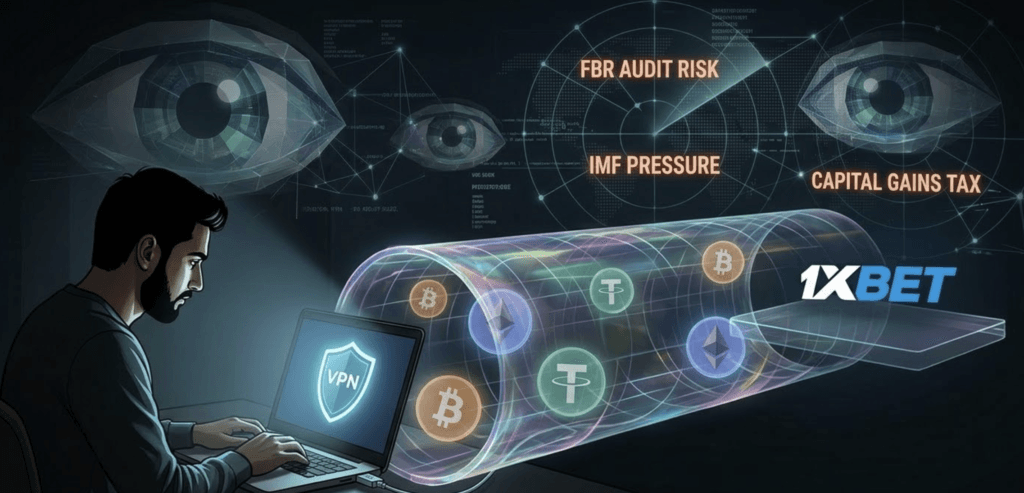
Let’s be clear—nobody shifts to crypto because they love blockchain technology. We do it because the Pakistani banking system has made fiat deposits practically impossible for offshore gaming.
Try running a Visa or Mastercard deposit through Meezan Bank, HBL, or Standard Chartered today. The Merchant Category Code (MCC) for gambling triggers an automatic block nine times out of ten. If you are lucky, the transaction just fails. If you are unlucky, the bank’s compliance team flags your account for suspicious outward remittances.
Even local mobile wallets are a nightmare. You hit transaction limits quickly, and the P2P agents taking a massive cut in the middle are incredibly unreliable. If you are still fighting with fiat and want to see the exact failure rates of local cards, I documented the entire mess in this complete 1xBet Pakistan deposit methods comparison.
This friction is why crypto took over. It isn’t about evading taxes initially; it is about pure functional access. You send TRC-20 USDT, it bypasses the central bank’s gateway entirely, and your 1xBet balance updates in three minutes.

Here is how the reality actually looks on the ground:
| Metric | Local Banking / Cards | Mobile Wallets | Crypto (USDT/TRX) |
|---|---|---|---|
| Success Rate | ~15% (Heavy MCC blocks) | ~60% (Agent dependent) | 99.9% (Blockchain reliant) |
| FBR Visibility on Deposit | High | Medium | Zero |
| Speed to Account | Hours to days | 10-30 mins | 1-5 mins |
| The Real Danger | Account freeze by bank | Scammed by local agent | Tax audit upon P2P cashout |
The FBR Tax Trap Nobody Warns You About
Here is the part the Telegram “gurus” get completely wrong. Pakistan does not have a specific tax on online gambling winnings because the activity itself is outlawed by the NCCIA. But they absolutely tax digital assets.
The Federal Board of Revenue (FBR) classifies cryptocurrency under the Income Tax Ordinance. When the IMF pushed Pakistan to broaden its tax base, digital assets were explicitly put on the menu. If you generate a profit from an asset—whether you traded it on Binance or won it betting on the PSL on 1xBet—that value is subject to standard income tax slabs, which can scale up to 35%, plus potential capital gains taxes.
Does the FBR have a magical algorithm tracking your specific 1xBet deposit address? No.
The trap doesn’t snap shut when you deposit. It snaps shut when you cash out.
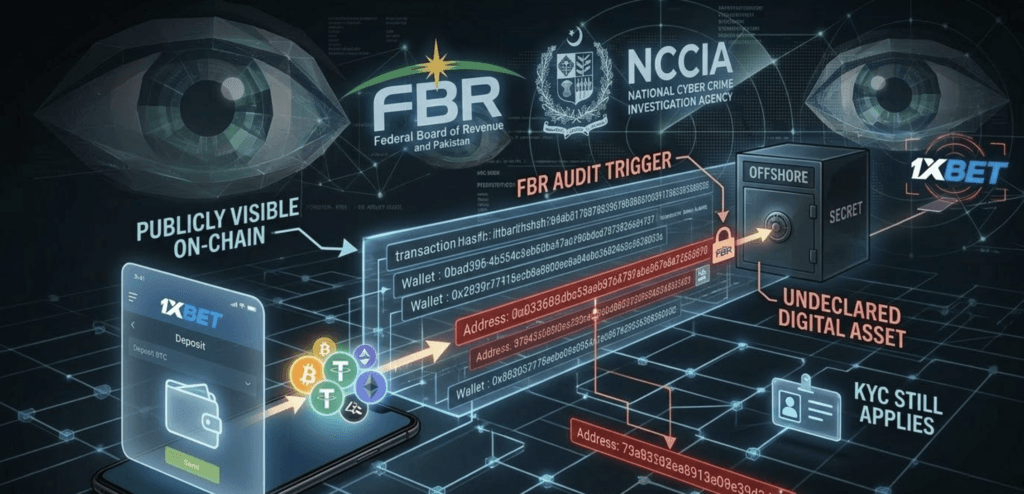
When you win big, withdraw your USDT, and hit a P2P exchange to convert it to PKR, you leave a massive, glaring footprint. If your bank suddenly sees Rs. 500,000 hit your account from three different unknown individuals (the P2P buyers), their automated anti-money laundering (AML) systems will flag you. The bank reports this to the FBR. The FBR asks for your source of income. If your answer is “undeclared crypto wealth from an offshore sportsbook,” you are in for a very bad year.
My Personal Deposit Blueprint (No ERC-20 Allowed)
When I fund my 1xBet account, I treat the payment routing with the same cold math I use to calculate a betting line’s Expected Value (EV). Wasting money on gas fees or risking a locked transaction is a massive negative EV play.
1xBet’s crypto cashier is actually one of the best in the industry because it generates dynamic, single-use wallet addresses. This stops lazy blockchain analysts from tracing your funds directly to a known casino hot wallet.
Here is my non-negotiable rule: I only use the Tron network (TRC-20) or Binance Smart Chain (BEP-20) for USDT.
I see rookies using the Ethereum network (ERC-20) and burning $15 in gas just to deposit a $50 bankroll. That is financial suicide. Tron costs less than a dollar and confirms almost instantly. If you need the exact limits, node confirmation times, and coin alternatives, I keep an updated log of the network metrics in my 1xBet Crypto Express Guide. Read it before you accidentally send funds to the wrong network chain, which is a mistake 1xBet support will not refund.
Surviving the Withdrawal Bottleneck
Depositing is easy. Getting your money out is where the house tests you.
The moment you request a crypto withdrawal, 1xBet’s security algorithm runs a check. Did you deposit in USDT but try to withdraw in Bitcoin? Denied. Did you log in from a heavily blacklisted VPN IP address? Flagged for KYC. Did you deposit, place zero bets, and try to withdraw? Account locked for suspected money laundering.
When players DM me complaining that their crypto withdrawal has been stuck in “Processing” for 48 hours, it is almost never a blockchain issue. It is a platform security trigger. Before you start spamming their live chat and making things worse, look at the exact protocols I use to force through a 1xBet Withdrawal Pending in Pakistan. You have to play by their internal risk-management rules if you want your money released quickly.
The 0.1% Expert Verdict: Pricing Your Risk
As a professional in this space, here is my final read on the board.
Using cryptocurrency for 1xBet in Pakistan is the only logical way to bypass the archaic, hostile banking infrastructure. It gives you localized privacy and guaranteed access to your betting markets. But calling it “tax-free” is a dangerous lie born out of temporary enforcement gaps.
You are trading the immediate risk of a bank block for the delayed risk of an FBR audit. Smart players manage this by keeping their betting bankroll completely segregated in decentralized wallets, and carefully managing the volume of their P2P PKR cash-outs to stay under the bank’s AML radar.
Unfiltered FAQ & Pitfalls
Can I use a VPN to hide my crypto gambling from the Pakistani government?
A VPN only hides your IP address so you can access the 1xBet domain when the PTA blocks it. It does absolutely nothing to hide your financial transactions. If you cash out crypto to your local bank via P2P, the FBR does not care what IP address you used; they care about the PKR hitting your account.
What happens if I send USDT to 1xBet using the wrong network (like sending BEP-20 to an ERC-20 address)?
Your money is permanently gone. Blockchain transactions do not have a “chargeback” button. 1xBet’s payment gateway will not recognize the deposit, and their support team cannot recover cross-chain errors. Always send a $5 test transaction if it is your first time.
If my local bank calls me about a P2P transfer, should I mention crypto?
This is the classic pitfall. The moment you mention cryptocurrency trading, most Pakistani banks will immediately freeze the account per State Bank of Pakistan (SBP) guidelines. This is why high-volume players keep their primary salary/business accounts completely isolated from the accounts they use for P2P crypto liquidations.



Thank you for being such an authentic voice in this space
This is what I should do.
This is exactly what our community 💎 needed to hear right now
thank you