
Table of Contents
How to Bet on CFL at 1xBet Canada: A Complete Guide to Betting & Tax on Winnings
People don’t talk about the CFL the way they talk about the NFL. That’s fine. It means the markets are softer, the lines open with less precision, and the bettors doing actual research consistently encounter edges that don’t exist anymore in over-analyzed leagues.
I’ve been betting Canadian Football League games for several seasons now, and the honest truth is that it took me longer than it should have to take this league seriously as a betting market. I kept treating it as a sideshow to the NFL slate. That was a mistake. Once I started tracking my results by league, CFL was consistently outperforming everything else on my sheet — not by accident, but because the information environment rewards preparation in a way that the NFL stopped doing years ago.
This guide covers how to actually bet on the CFL through 1xBet as a Canadian player — not just which buttons to click, but what’s happening underneath the surface of each market and why it matters. The tax section at the end is worth reading even if you already think you know the answer, because most people slightly misunderstand the CRA’s position. (🔥 Join 1XBET now! Click [betx100.com] → Code: betxone → 💰 100% BONUS!)
The CFL Is Not a Smaller NFL. Stop Treating It Like One.
This is the single most important reframe before we get into anything else.
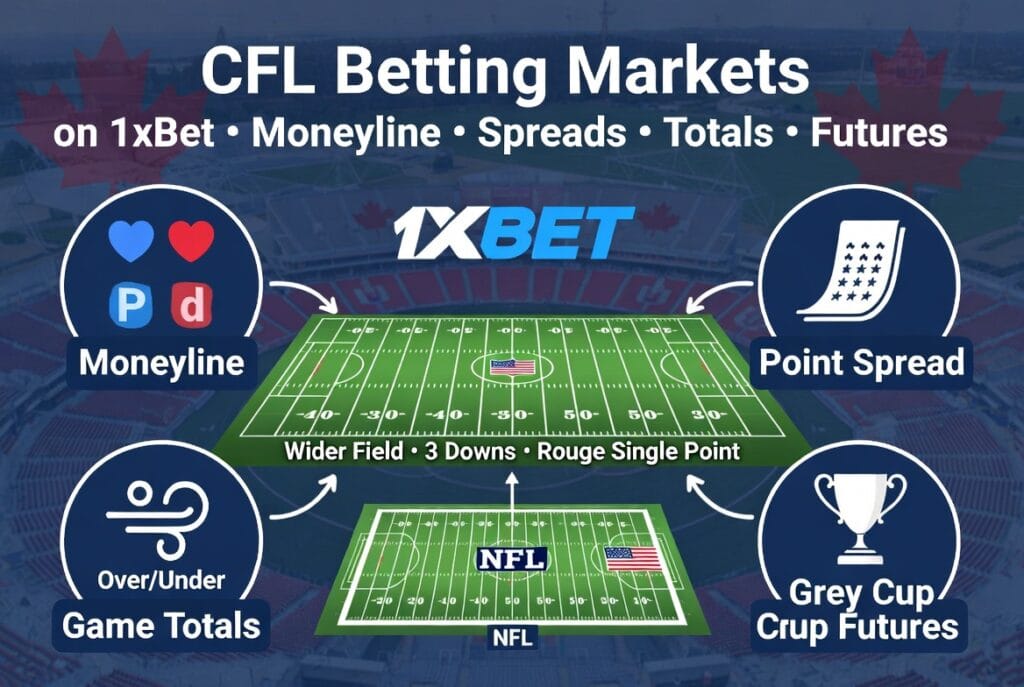
The three-down format changes everything. Without a free down to absorb a conservative second-down call, offensive coordinators in the CFL are making aggressive decisions on second down that their NFL counterparts wouldn’t even consider. That generates faster drives, more frequent punts, and a rhythm that produces lead changes at a higher rate than the NFL does. When you’re betting spreads or totals, that tempo has direct consequences you need to build into your thinking.
Then there’s the rouge. If you’re new to the CFL, this one’s going to feel strange: a team scores a single point when a kicked ball — whether a punt, a missed field goal, or a kickoff — is not returned out of the end zone. One point. On a missed kick. It sounds like a novelty until you watch a late-game scenario where a team down three accepts a rouge to make it a two-point game, then recovers an onside kick. Final scores in the CFL turn on this rule more often than most people realize, and final scores are the entire ballgame when you’re betting spreads.
I’ve seen recreational bettors lose final-minute spread bets because they didn’t know a rouge was possible. That’s not a strategic failure — it’s just not reading the rulebook before putting money on the outcome.
Getting Set Up on 1xBet: What You Need to Know Before You Deposit
Your Province Matters More Than the Platform
Before anything about odds or markets — you need to know where you stand legally. If you’re in Ontario, 1xBet is blocked, full stop. The province built its own licensed iGaming framework in 2022 and 1xBet isn’t part of it. Don’t waste time trying to work around it.
If you’re anywhere else — Alberta, BC, Saskatchewan, Quebec, Manitoba, the Atlantic provinces — you’re in a different situation. The Canadian Criminal Code regulates operators on Canadian soil, not Canadian citizens placing bets on overseas servers. There’s no federal law that makes using an offshore sportsbook illegal as a bettor. The full breakdown of exactly how this plays out province by province is in the 1xBet legal guide for Canada covering Alberta, BC, Quebec and beyond, and I’d genuinely recommend reading it before depositing anything, because the nuances matter — especially if your bank flags the first transaction.
KYC First. Seriously.
Register with your email. Fill out your account details accurately — and I mean accurately, down to the exact spelling of your name and the exact address on your government ID. Then upload your documents before you place your first bet.
I know that sounds overly cautious for a new account. But here’s what actually happens if you skip it: you win, you try to withdraw, and then the platform asks for verification. Now you’re racing against your own impatience while documents sit in a review queue. The KYC process on 1xBet for Canadian players takes 24–72 hours when submitted correctly. Submit it on day one and it’s a non-issue for every cashout after that.
Funding: Interac Is Still the Right Answer for Most Canadians
Visa and Mastercard can work, but credit card deposits to offshore betting accounts get blocked by certain Canadian banks with no warning and no explanation. Crypto is genuinely fast and fee-free if you’re comfortable with a wallet. But for most Canadian bettors who want simplicity, Interac e-Transfer is the cleanest option — it’s domestic, it’s familiar, and banks don’t flag it the way they flag overseas card transactions.
The timing of your withdrawals matters more than most people expect. Submissions on Tuesday or Wednesday mornings clear significantly faster than Friday afternoon requests, which routinely roll into the following week. For a thorough breakdown of processing stages, minimum amounts, and the specific fixes for every common “stuck withdrawal” scenario, the 1xBet Interac withdrawal guide covers all of it — and covers it better than I could replicate here without just rewriting the same article.
CFL Betting Markets on 1xBet: Which Ones Are Actually Worth Your Time
Moneyline
The moneyline on CFL games is where I consistently see recreational bettors overpaying for favorites. The Winnipeg Blue Bombers and Toronto Argonauts attract more public money than any other teams in the league, partly because they’re the most visible franchises nationally, and partly because the Bombers in particular have been genuinely dominant in recent seasons.
But here’s the thing: heavy public action on a nine-team league compresses the lines on those teams in a way that eliminates real value. A -200 moneyline on a team that wins 60% of the time is a losing bet. The implied probability at -200 is 66.7%. You’re paying for more confidence than the data supports.
The more interesting moneyline value tends to live on the east division underdogs — Ottawa and Montreal specifically — when they travel west for divisional games. Those games draw minimal public betting interest, which means the lines stay closer to their opening price. When a sharp line on a competitive matchup goes largely untouched because the public doesn’t care, the book doesn’t need to shade it in either direction. That’s a clean number to bet into.
Point Spreads: The Most Exploitable Market in Canadian Professional Sport
CFL spreads are a thinner market than NFL spreads. That’s not a criticism of 1xBet specifically — it’s a reality of how many bettors are watching and engaging with the market in real time. A thin market means two things: lines open with less precision, and they move faster when money hits them.
I’ve tracked CFL spreads over multiple seasons and a consistent pattern holds: lines that open on 1xBet on Monday or Tuesday for a Saturday game frequently move 1.5 to 2.5 points by kickoff. The direction of that movement tells you something. When sharp money hits a side early and moves the line significantly, you want to know that before you place your bet at the closing number.
The practical habit this creates: check the opening line, then check the current line before betting. If a spread has moved from -3.5 to -5.5 against your pick, you’re either late to a sharp move or you’re about to fade sharp money with no basis for doing so. Either way, you should know which situation you’re in.
Half-points matter more in CFL betting than in most leagues. Final margins of exactly three or seven points are extremely common in Canadian football — same as American football, for the same reason (three-point field goals and seven-point touchdowns dominate scoring). Getting -3 instead of -3.5 on a favorite is worth paying a slightly worse moneyline price to achieve. That’s called buying the hook, and it’s mathematically sound in this context.
Totals: October Changes Everything
CFL totals in June and July are a different animal from October and November. Summer games between offensive-minded teams in warm stadiums can push into the mid-50s. Late-season divisional games in Regina or Winnipeg in 15°C with a 30 km/h crosswind are a completely different calculation.
The book adjusts for temperature and precipitation. They’re slower on wind. Specifically: sustained crosswinds above 25 km/h destroy deep passing routes in both directions and force offenses into shorter, lower-percentage throws. Total scoring in high-wind CFL games trends approximately 10–14 points below the posted line in the data I’ve tracked personally — and the public still bets overs in those games because people remember how the team scored in the previous week’s sunshine game.
My rule: if the wind forecast at kickoff exceeds 25 km/h and the total is set above 47, the under has a structural case that doesn’t require you to know anything else about either team.
Grey Cup Futures: Two Windows, One Rule
The Grey Cup futures board on 1xBet is one of the most mispriced markets you’ll encounter in North American professional sport. Nine teams. A compressed schedule. And most recreational bettors don’t even look at futures until the playoffs are set — at which point every bit of value has already been priced in.
The two windows where Grey Cup futures are worth your attention:
Preseason, specifically week three and four of camp. By this point, training camp competitions have resolved, injury situations have partially clarified, and you have meaningful quarterback depth chart information. But the futures prices haven’t fully adjusted from their offseason post because the public betting volume doesn’t flow until the regular season opens. The delta between what the market knows and what it’s priced is widest right here.
Immediately after a major roster move mid-season. A starting quarterback trade, a key defensive tackle going on the injured list, a head coaching change — the futures board takes 48–72 hours to fully reprice after major transactions. That lag is real and it’s repeatable. Set up news alerts for CFL transactions. Check futures prices the morning after a major move. That’s a habit that produces opportunities four or five times per season.
Live Betting: The Two-Minute Problem
1xBet’s live CFL market updates in real time through the fourth quarter. This is where understanding CFL rules pays a direct financial dividend.
In the NFL, teams get a two-minute warning in both halves — a built-in timeout that gives defenses a rest and allows coaches to regroup. In the CFL, there’s one two-minute warning: fourth quarter only. No second-half warning in the third quarter.
What this means in live betting: teams trailing by a possession in the late third quarter accelerate their pace without an upcoming stoppage protecting the defense. Completion rates go up. Drive lengths shorten. Scoring pace picks up faster than the live total adjusts. In a one-score game with five minutes left in the third quarter, if the live total hasn’t moved to reflect the upcoming pace change, you have a concrete, rules-based argument for a live over.
This is the kind of edge that doesn’t come from watching a betting tip account. It comes from actually understanding the sport well enough to know what should happen before the model catches up.

Know the Settlement Rules Before You Build a Parlay
One thing that catches people off guard: 1xBet settles CFL wagers under its American football rules framework. This matters most in multi-leg parlays or player prop bets, where the settlement criteria for suspended games, overtime results, and individual performance thresholds can differ from what you’d assume going in. The 1xBet American football betting rules guide is where you find the specifics. Reading it once saves considerably more frustration than finding out at settlement time.
The CRA and Your Winnings: What’s Actually Taxable
Most Canadian bettors either think they definitely owe tax on their winnings or think they definitely don’t. The real answer has more shape to it than either assumption.
The Canada Revenue Agency’s formal position — documented in Income Tax Folio S3-F9-C1 — is that gambling winnings are not taxable income for recreational bettors. Windfall gains from wagering are explicitly excluded. That $8,000 Grey Cup parlay, the $1,500 spread run through October, all of it: not reportable, not taxable, yours completely. This holds regardless of how much you win.
The situation changes when betting becomes your primary livelihood. The CRA classifies professional gamblers as running a business, and business income is taxed. Here’s what triggers that classification:
| Factor | What the CRA Looks For |
|---|---|
| Income dependency | Is betting your primary source of income? |
| Commercial intent | Are you operating with systematic profit-seeking methodology? |
| Business-style conduct | Do you maintain records the way a business would? |
| Reliance on winnings | Do you depend on betting proceeds for regular expenses? |
You need to meet all of these simultaneously for the professional label to apply. Betting regularly through a full CFL season while holding a day job doesn’t make you a professional gambler. Volume alone doesn’t. Losing streaks don’t matter to the CRA — they’re looking at intent and structure, not results.
One thing that genuinely surprises people: if you take your winnings and invest them, any returns on those investments are fully taxable in the normal way. The original gambling win wasn’t income. But dividends, interest, and capital gains generated from money you won are — and they get reported on a T3, T5, or T5013 depending on the investment vehicle.
If you ever find yourself in a dispute about your betting classification, the CRA looks for records. Even recreational bettors benefit from keeping a simple log — deposit amounts, bet history, withdrawals — not because you owe tax, but because documentation is what proves your activity was recreational when the question is asked.
Mistakes I’ve Watched People Make Repeatedly
Betting their home team’s games every week, no exceptions. CFL fandom runs deep — Saskatchewan Roughriders fans especially have an almost religious attachment to their team. Betting with that attachment in play isn’t strategy. It’s paying an emotional premium for action on a game you’d watch anyway. Recognize your biases by province.
Treating a strong September as proof of a system. Ten bets is not a sample size. Neither is twenty. I didn’t know whether my CFL approach was actually producing positive expected value until I had 80+ documented bets with verified odds. Before that, it was just feelings with receipts.
Building a parlay around a game you haven’t researched. CFL schedules are compact enough that there are genuinely only a handful of competitive, well-analyzed matchups per week. Adding a sixth leg to a parlay because the odds look appealing — when you have no actual position on that game — turns a research-based play into a coin flip with worse math.
Trying to withdraw before KYC is done. I covered this above, but it keeps coming up. Submit your verification on day one.
Ignoring the game-day injury report. The CFL releases injury designations before kickoff, similar to the NFL practice but with far less national attention. A starting quarterback listed as questionable who doesn’t suit up moves the line by three to four points if the book adjusts in time — and sometimes it doesn’t before kickoff. Follow the official CFL injury reports the morning of each game.
FAQ: Real Questions With Direct Answers

Is 1xBet available for CFL betting in my province?
Yes, if you’re outside Ontario. British Columbia, Alberta, Saskatchewan, Manitoba, Quebec, and Atlantic Canada can all access the platform without issue. Ontario is geo-blocked entirely. Don’t attempt workarounds if you’re based there — the KYC process will catch it and your account will be restricted.
Do I pay tax on CFL betting winnings in Canada?
Not if you’re a recreational bettor, which covers the vast majority of people reading this. The CRA classifies gambling winnings as windfall income, excluded from taxable income. Professional gamblers — those who bet as their primary commercial livelihood — are taxed differently, but that standard is much higher than most bettors reach.
What’s the minimum bet for CFL games on 1xBet?
$0.10 USD equivalent, which gives you genuine flexibility to test markets at extremely low stakes before scaling up.
Can I use Interac to withdraw my CFL winnings?
Yes. Interac is the cleanest withdrawal channel for Canadian players and is fully supported on 1xBet. The timing and process details are covered properly in the Interac withdrawal guide rather than summarized here in a way that might leave gaps.
What happens to my CFL parlay if a game gets suspended?
1xBet settles CFL wagers under American football rules. The specific criteria for suspended games — including how far the game must progress for bets to stand — are in the football rules guide. Check it before building multi-leg CFL parlays, not after.
Why do CFL spreads move so much more than NFL spreads?
Thinner market. Less public volume means individual bets move the line more dramatically than they would on a heavily bet NFL game. Opening CFL lines often have two to three times more built-in uncertainty than NFL equivalents. That volatility is the same reason sharp moves get rewarded at better prices in this league.
Is it worth betting CFL props on 1xBet?
Honestly: they’re hit and miss. Early-season props on passing yards and rushing attempts are frequently soft because team usage patterns haven’t established themselves yet. By mid-season, when a team has ten or twelve weeks of consistent play-calling data, props become considerably more interesting. Don’t build a strategy around early-season CFL props — wait until the data is actually meaningful.
The CFL rewards preparation more clearly than any other professional sport I’ve bet on consistently. Nine teams. Eighty-one regular-season games. A fully predictable playoff structure. The league is small enough that you can actually know something about every team by mid-season — their offensive tendencies, their coaching philosophies, their depth chart vulnerabilities — in a way that’s genuinely impossible when you’re trying to track 32 NFL rosters simultaneously.